
Information is the oil of the 21st century and analytics is the combustion engine.Peter Sondergaard, Senior Vice President and Global Head of Research at Gartner, Inc.
Data analytics is evolving at an exponential pace. In stark contrast, the pace of change for organisations en masse remains significantly slower. According to Demand Sage, over 97% of businesses have invested in Big Data, yet only 40% use analytics effectively. This gap is because analytics does not function in isolation. Its output, inherent accuracy, impact and relevance are determined by the strength of the analytics layer, including how organisations define enterprise data warehousing and modernise legacy environments. It is this layer that structures, contextualises and interprets data using advanced analytics.
In 2026, this disconnect is becoming both more visible and expensive, particularly across general insurance and technology insurance sectors where real-time decisions increasingly shape competitiveness.
AI agents, cloud-native platforms, real-time processing, generative AI and retrieval-augmented generation (RAG) are no longer experimental capabilities. It is data analytics that drives them. They now sit at the core of modern business intelligence and analytics strategies, powered by scalable platforms such as the cloud data warehouse. Yet many organisations continue to rely on legacy data warehousing solutions, fragmented systems and operating models designed for a far slower world. Presently, around 90% of global data is unstructured, creating fundamental challenges for retrieval-augmented generation and AI-driven analytics, as per Demand Sage. This is especially evident in insurers such as progressive insurance, where data velocity directly impacts underwriting and claims outcomes.
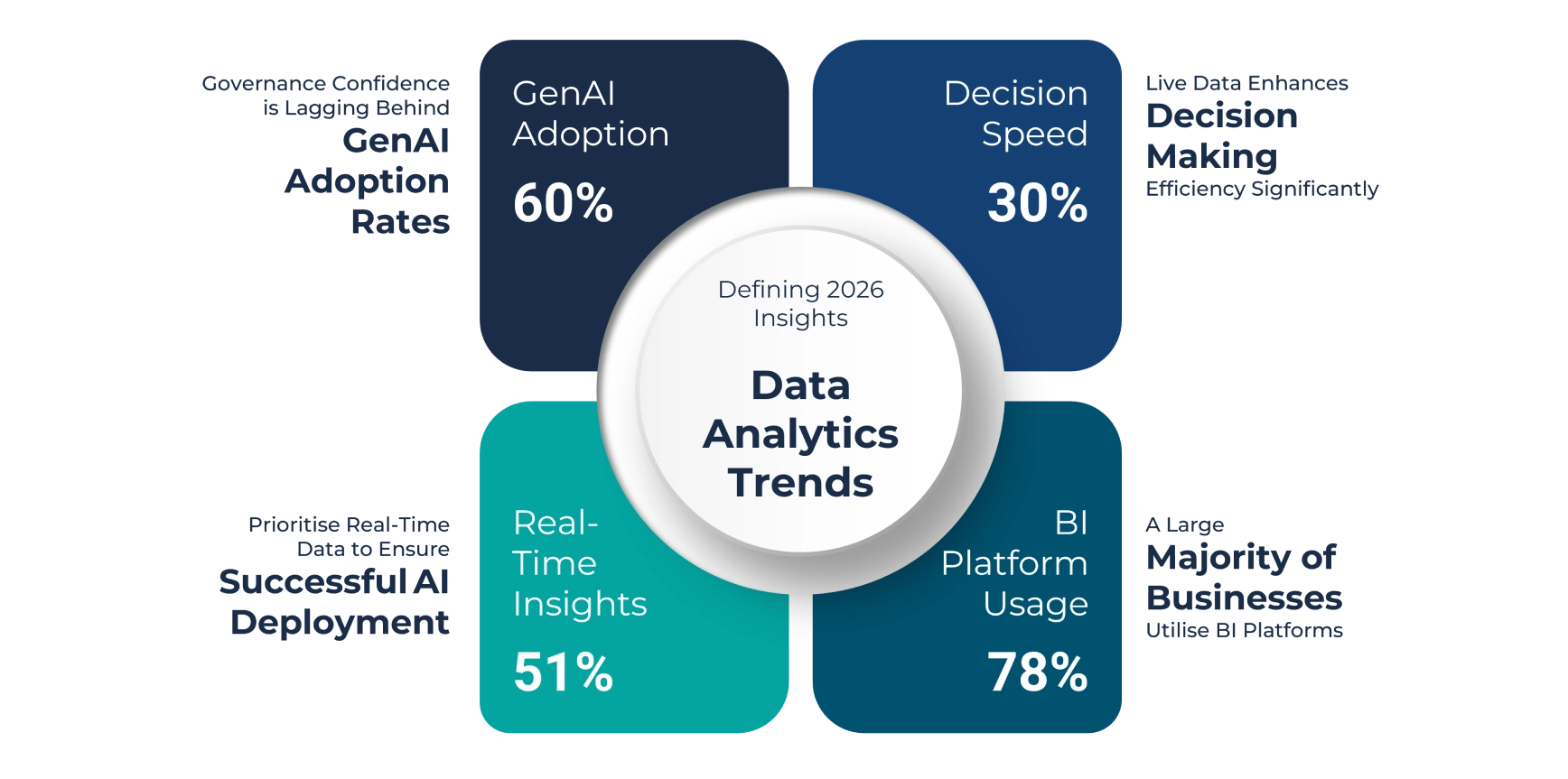
Key Shifts in Data Analytics in 2026
Technical prowess
Structured Query Language (SQL) bottlenecks are now weeded out by Generative AI. One can query data using natural language. This approach accelerates access to insights and reduces the dependency on database specialists, particularly when operating across distributed cloud environments.
Models
AI agents can interact with data seamlessly with the aid of model-driven architectures (MDA) and large language models (LLM). Contextual analysis, reporting and predictive modelling can be automated sans manual intervention, enabling analytics-led decisioning across insurance value chains.
Governance and quality
The main emphasis is still on data quality. Frameworks for governance are essential. Intellectual property (IP) protection, tagging and audit trails are now commonplace. Analytics results become far less reliable without them, especially in regulated industries such as general and technology insurance.
Real-time data
Real-time data processing is imperative, along with edge analytics and streaming data pipelines.. Such technologies must remain competitive, particularly as AI agents act on insights instantly rather than retrospectively.
Data mesh vs Data fabric
Organisations are shifting away from IT-owned centralised data piles. Teams can take ownership of their own data domains thanks to the data-mesh. These domains are combined into a single layer by the data-fabric. Together, they strike a balance between integration and autonomy, especially during large-scale cloud migration services initiatives.
The Human Factor
AI now handles the “how” of data processing. You gain valuable time to focus on critical business insights due to less noise and greater clarity. Your teams can also focus on making the decisions that matter.
Insights to Advantage
In 2026, data analytics is more than just a process that has to be adopted. Its scope has widened to include governance, quality and speed. For most enterprises the data analytics journey involves transitioning from disjointed systems to cohesive layers, often anchored by a cloud data warehouse. Such systems improve accessibility to data, giving your teams the flexibility to act on insights while AI extracts the finer details from your data. . Thus analytics transforms from insights to advantage.
Challenges Affecting Data Adoption
Despite its usefulness and potential to evoke positive change, analytics maturity is still uneven. Data is often stored in systems built with outdated technology, affecting its quality.. Problems with data quality erode adoption and trust. Latency affects real-time decision making. On top of that, security and regulatory requirements add complexity, particularly for insurers operating at scale.
Addressing these challenges requires strategic planning and investment in modern data engineering, cloud-native architectures, robust governance frameworks and cloud migration services designed to support AI-driven analytics at scale.
With Data, Information Becomes an Advantage
Transforming insights into long-term advantage will be the chief criteria to assess analytics maturity in 2026. Businesses that align technology, governance, and decision-making around a common analytics vision and treat data as strategic infrastructure rather than a byproduct of operations will be successful. Most decisions are still made by people, not machines and platforms.
Insights from analytics offers better clarity, reduces cognitive overload, mitigates biases , enabling decision-makers to pivot with confidence.