Why the future of enterprise decision-making belongs to partners, not replacements.
A doubles partnership in professional sport is rarely built on having two players who are exactly alike. It relies on complementary strengths, instinct and mutual trust. One partner commands the baseline; the other owns the net. The objective is never for either player to play every shot, but to understand each other’s strengths and work together to win.
It is a dynamic enterprise leaders need to understand as they navigate artificial intelligence.
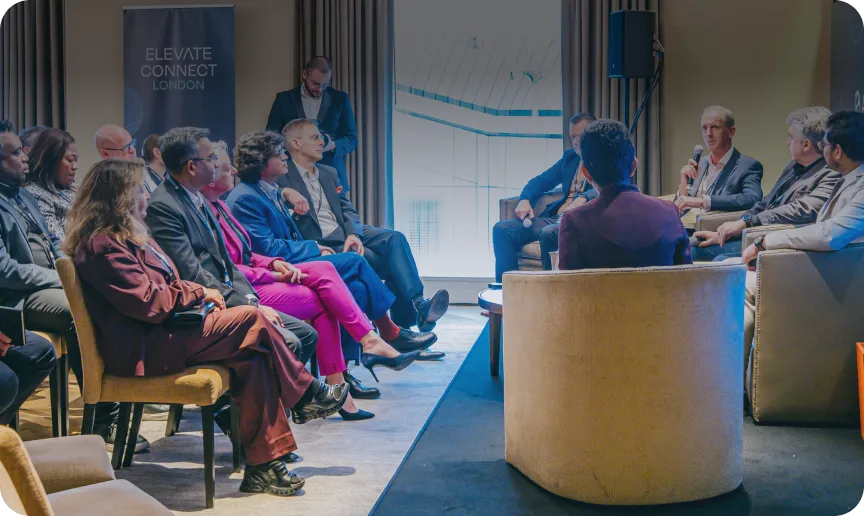
During a fireside chat at Elevate Connect London, Mayank, Founder and CEO of ADROSONIC, sat down with Hasani Jess, Group CTO of Aventum Group, to discuss the realities of AI adoption. Moving beyond the usual conversations around automation and AI capabilities, their discussion explored a more fundamental question: how can people and AI work together to achieve better outcomes?
Their discussion returned to an unconventional starting point: 18-time Grand Slam champion Leander Paes.
What the Algorithms Miss
When looking at Paes’s early career, Mayank pointed out an interesting paradox, “At 5’10”, competing in an era dominated by 6’2” power servers, with a background in football and limited domestic training infrastructure, standard algorithmic modeling would have written him off. Fed into predictive data systems, professional tennis would have been the least recommended athletic path.”
Yet Paes went on to dominate the global stage for three decades. His success was not simply about individual ability, but also about mastering doubles and partnering with players whose strengths complemented his own.
That distinction offers an interesting perspective on the opportunity with AI.

“What is the point of competing with AI at everything? As humans, we have limitations. There is no way we can out-compute machine scale. But what we can do is read the room. We bring empathy, judgment, agility, and context. If you partner effectively, that is how you win Grand Slams.”
The opportunity is not to compete with AI at what it does best, but to understand how its capabilities can complement human judgement. AI can process information at a scale and speed that people cannot match, while people bring context, experience and the ability to respond to situations as they unfold.
The Trap of “Intoxicating Familiarity”
For technology leaders, one of the biggest challenges with AI adoption is managing expectations. As Hasani pointed out, AI can create an illusion of simplicity.

“AI is intoxicatingly familiar, when you watch an elite athlete on television, you can see something that was very familiar, you can see a person running around with a racquet, and you feel, I’m the same, we’re the same, and then you realise when you actually get the racquet and you’re on the field, we’re not the same. There’s an expertise element that they bring that looks interestingly simplistic.”
AI gives that exact same impression. Because anyone can interact with a prompt, organizations assume adoption is easy. But partnering with it to drive real business value takes discipline, expertise, and deliberate practice.”
That practice involves understanding how AI behaves, where it performs well and where it can get things wrong. Just as with any partnership, trust develops over time, through experience and an understanding of what each partner brings.
As Hasani quoted, “imagine a tennis player having to adapt to a new doubles partner every single week”. Maintaining an effective partnership requires continuous learning and the ability to adapt.
For organisations, this means AI adoption cannot simply be about introducing a tool and expecting results. People need the opportunity to understand it, build confidence in using it and learn how to work with it effectively.
Moving Beyond 1 + 1 = 2
Too many organisations approach AI simply as a way to complete existing tasks faster or reduce manual effort. While efficiency is important, Mayank highlighted a much bigger opportunity: using AI to expand what teams can actually achieve.
The distinction can be summed up as:
1 + 1 = 2: Using AI to automate an existing process and complete it faster.
1 + 1 = 11: Using AI to overcome limitations of time, resources and capacity, enabling teams to explore opportunities and take on work that may previously have been beyond their reach.
For instance, a team that may not have the capacity to conduct extensive research or analyse large volumes of information can use AI to do much of that groundwork. This gives people more room to assess the findings, explore possibilities and make informed decisions.
The focus, however, should always be on the problem before the technology. As Mayank highlighted, organisations need to understand the end-user, identify existing bottlenecks and look at how a process can be improved before introducing AI.
It is not about finding a place to use AI, but understanding where it can make a meaningful difference.
The Court Belongs to the Team
Intelligent systems can generate options, process information and take on tasks at scale. But the value comes from how people use those capabilities to make better decisions.
As AI continues to evolve, organisations and their people will need to keep learning, adapting and finding better ways to work alongside it.
The question for enterprise leaders is not whether AI can outperform humans at individual tasks. It is whether their organisations understand how to bring the strengths of both together.
In doubles, the strongest partnership is not about one player doing everything. It is about understanding each other’s game, knowing when to step in and creating opportunities that neither could achieve alone.
The same applies to AI. Its greatest value may not lie in replacing what people do, but in helping them achieve what was previously out of reach.